Friday, September 22, 2006

What They Say About The Pope's Controversial Statement...

A statement by Muslimen Sema, the mayor of Cotabato City...
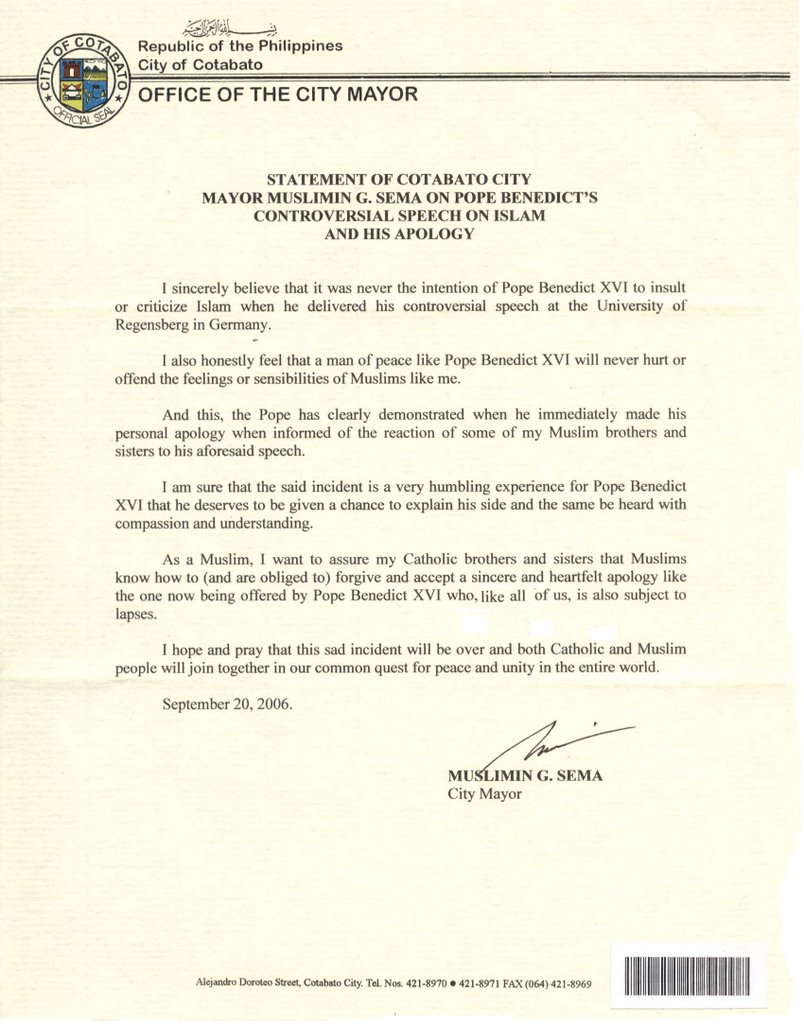

And of Fr. Sebastiano D'Ambra, an influential priest in Zamboanga City about the Pope's controversial articulation about Islam.
A Reflection About the Pope and Islam

I am deeply saddened and disturbed by the issue raised on the lecture of the Holy Father, Pope Benedict XVI, and I wish to be a voice ofmany silent Christians and Muslims who follow this issue with great concern.My voice is not to add new arguments in favor of or against the Pope.

It is clear that the Pope maintains his stand of respect to the MuslimUmma as was clearly stated in his letter, saying that he "sincerely regrets" that his words were interpreted in a manner contrary to his intentions.

In fact the statement recalls his meeting with representatives of Muslim communities in Cologne, Germany, on 20 August 2005 saying that "The lessons of the past must help us to avoid repeating the same mistakes. We must seek paths of reconciliation and learn to live with respect for each other's identity."

This reminder is for all.On many occasions, but especially on March 12, 2000 during the great Jubilee (a big event for the renewal of the life of Catholics), the Church has expressed its solemn apology to the world for the major sins committed by the Church in history.

We can find also "sorrow" declarations by respected Muslim leaders along the centuries. In light of this introduction my point of reflection goes to my experience. I arrived in the Philippines in January 1977 and after a few weeks I flew from Manila to Zamboanga City on the way to my first mission in Siocon, Zamboanga del Norte.

It was in Zamboanga City that I started to realize how deep were the feeling of prejudices of the Christians against the Muslims, and vice versa. Soon I understood that the conflict of the years has contributed to deepen the gap between the two communities. Both sides, Muslim and Christian people, have painful accusations against each other.

However, I have also heard beautiful stories of friendship among Muslims and Christians.The pain of those accusations was for me a challenge to give my contribution of friendship to the Muslim communities, taking some concrete steps to be closer to the Muslim Community of Siocon, helping in critical moments of conflict, risking my life on their behalf, etc.

I know I was criticized by some Christians, but I was convinced of my understanding of dialogue as an experience of love that starts from God and brings people back to God.

That initial experience of life in Siocon was for me a beginning to start, in 1984 in Zamboanga City, the Silsilah Dialogue Movement with some Muslim and Christian friends. I believe that in a difficult situation there are basically two ways to react: to take revenge or to love.What will be our choice in this moment?

I believe that the majority of Muslims and Christians are wiling to choose love, reconciliation, andcompassion, guided by the basic principles of the Holy Bible and the Holy Qur'an.

I am convinced that in this critical moment of history - when sectors of society on both sides are encouraging violence- we, the people ofthe silent majority, have to stand and unite our hands for peace.

It is time to put in place strategies to win over the other and work together for a common good. We have to take more concrete steps to overcome the temptation to resort to violence. We have to stand against sectors of society that try to remove God from their hearts, proposing a materialistic society as a model to achieve.

It is wrong to accuse Christianity for the sins of Western society; it is wrong as well to accuse Islam for some forms of violence coming from some Muslim sectors. I believe this is the worst of times for relations among cultures and religions, but it can become the best of the times if we, the silent voices among Muslims, Christians and people of other faith, will not allow ourselves to be used, but reaffirm instead our own faith,dignity and the basic ethic of the common good.

This is the time to make all possible efforts to call the people who represent the two brothers - Isaac and Ismael, both sons of Abraham -- to reconcile and believe that they have a common mission in the world today.

The mission of peace, through dialogue based on the experienceof our own faith, encourages us to contribute for the future peace in the world. The enemies of Islam and Christianity are in our midst no matter they claim to be Muslims or Christians or members of other religions.

The great problems today come not from those who practice their religion with sincere heart, but from those who try to put God out of our lifeand society.Christians and Muslims have in common a belief about the end of our life.

The Holy Qur'an and the Gospels say that at the end of our lifewe will be judged. Are we ready for that day? How can we help each other to prepare ourselves? Perhaps we have to start saying to each other, with sincerity and respect for each of our religions, the expression of Jesus "Peace be with you," the same expression commonly repeated by the Muslim in Arabic "Assalam 'Mualaikum" and the answer "And also with you," which in Arabic is "Alaikum Muassalam."


Fr. Sebastiano D'Ambra, PIME
President Silsilah Dialogue Movement
Zamboanga City

Muslims Appeal For Help In Maguindanao

(A Mindanao Examiner Video)
MAGUINDANAO (Juan Magtanggol / 22 Sept) Salamona Hakim, a grade school principal in Camp Abubakre as-Siddique, a former base of the Muslim rebel group, Moro Islamic Liberation Front, appeals for book donations and humanitarian assistance for some 300 Muslim children in Tugaig town in the southern Philippine province of Maguindanao, torn by wars in the past.

The area was bombed in 2000 by government forces during one of the bloodiest war against the MILF in the restive region. Hundreds were killed and wounded and tens of thousands of Muslims, women and children, had fled their villages. Their homes were destroyed and only in recent years that most of them returned, but without shelters and livelihood, many until now live in poverty.

Some families were given housing units donated by different non-government and private organizations around the Philippines and abroad, but help is not enough and thousands more are without homes.

Smart Communications, the cellular phone giant, donated 100 housing units just this year in the towns of Tugaig and Barira, also in Maguindanao, to help the poor.

Now called, Smart’s Gawad Kalinga Villages, some 700 people now have a descent place to live and thanks to Smart, but more is needed to help the many who are still begging for help – from shelters to clothing, books and other things for the children, and medical care and potable water system and electricity.(Salamona Hakim has four volunteer teachers helping provide education to poor children in GK Villages. She can be reached at this number +63921 6306433)

Thursday, September 21, 2006

Zamboanga City Is Now Branded As Asia's Latin City

Mayor Celso Lobregat of Zamboanga City gestures Thursday, 21 Sept 2006 during a gathering with dozens of reporters and editors. (Mindanao Examiner)


ZAMBOANGA CITY (MIndanao Examiner / 21 Sept) Mayor Celso Lobregat on Thursday gathered dozens of local journalists and appealed to them to help promote Zamboanga City as "Asia's Latin City."

Lobregat explained that the basis for branding the Zamboanga as a Latin city is the existence of Chavacano, a derivative of the Spanish language that in turn is an outgrowth of Latin, the old Roman tongue.

The local government formally launched last month the branding of Zamboanga as “Asia’s Latin City,” in a simple ceremony held during the opening of the 15th Mindanao Business Conference at the Astoria Regency in Pasonanca Park here.

Chavacano is spoken by a majority of the people here, in Basilan and other parts of the Zamboanga Peninsula.

"We are the only city in Asia that speaks the Chavacano dialect, which is derived from the Spanish language," he told about 50 reporters and editors at the Garden Orchid Hotel.

Nostalgically, Zamboanga has been known as the “City of Flowers,” but Lobregat said other cities have also been planted to flowers and could be more abundant with flowers than Zamboanga nowadays.

“Zamboanga City has been known as the ‘convention capital of the country’ or the ‘sardines’ capital,’ because canning factories here provides about 70 percent of all sardines sold and consumed in the country today,” he said.

Yet, the city has what others may not have at all—Chavacano, where more than 70 percent of its vocabulary is pure Spanish in nature and origin.
The remaining percentage of Chavacano is picked from local dialects, according to the official Philippine News Agency.

The growth of Chavacano in Zamboanga can be traced to a concentration of Spanish nationals in Zamboanga at the height of the Spaniards colonization efforts in Mindanao that lasted for centuries until the late 1800.

“The branding of Zamboanga as Asia’s Latin city is the result of the City Development Strategies program spearheaded by the League of Cities, the World Bank and the involvement of the different local sectors,” Lobregat said.

Local officials said this would give the city a positive shift since it carries an international appeal and anchored on the rich Castilian influence and history of Zamboanga City.

The branding of Zamboanga will provide the city with a competitive global outlook instead of just comparing it with other cities in Mindanao. Call centers, like G-Com, has started recruiting agents from Zamboanga because they could easily be trained to speak Spanish.

Spanish is the second most spoken language after English and call centers need Spanish-speaking agents to serve their clients in Central and South America and Europe.

Lobregat also unveiled on Thursday a theme logo for next month's Christian celebration here of the Fiesta Pilar honoring the Virgin Mary. With the theme, "Alegria! Alegria! Adelante Zamboanga," Lobregat said the weeklong feast, held every October 12, is expected to draw thousands of tourists because of the city's rich cultural past.

Zamboanga City had been under Spanish rule in the past and was also used as a base for American soldiers. The city is also popularly known as "Zamboanga Hermosa."

U.S. Hands Over Development Projects In Cotabato

COTABATO CITY (Abdullah Cusain / 21 Sept) The Unites States handed over to Filipino officials in Cotabato City several development projects worth more than P19 million as part of Washington's assistance to help uplift the living standards of Muslims in the southern region of Mindanao, officials said on Wednesday.

The United States Agency for International Development (USAID), through its Growth with Equity in Mindanao (GEM) Phase 2 Program, also signed an agreement with Muslimen Sema, the mayor of Cotabato City, for a new water system.

The U.S. agency also handed over to the local government seven new passenger jeep stops are turned-over September 20 by the aid agency to the local government.

Sema signed the memorandum of agreement with Ronaldo Ypil, regional manager of the USAID-GEM 2 regional manager, and Delfin Hilario, general manager of the Metro Cotabato Water District (MCWD), for the construction of a 4-kilometer transmission pipeline and 23 communal faucets for the villages of Tamontaka 2 and 3, which have a population of more than 4,000.

"The villagers get their water from wells," the mayor told the Mindanao Examiner.

The transmission pipelines and communal faucets, which make up 70% of total project cost, will be provided by USAID-GEM 2 and the rest by the MCWD. The city government, on the other hand, will pay for the acquisition of the road's right-of-way, security and other non-cash expenditures.

During the signing rites Tuesday, Sema also announced that the villages of Kalanganan 1 and Poblacion 9 will also have their own potable water system soon in the same partnership with GEM-2 and MCWD.

Sema and Noel Ruiz, deputy project manager of the GEM-2, led other officials in the handover ceremonies for 3 jeep stops located at ND Village Elementary School, the New City Hall and in the so-called Espino area.
These jeep stops were part of the P19-million small infrastructure projects sourced out by Sema from the USAID-GEM-2 with 25% counterpart fund from the city’s coffers. Other projects include community centers, boat landing, drainage canal improvement, water supply expansion and box culvert construction in selected villages.

MAGHUSAY TA! By Uriel Cruz Vallecera In Cebu

MAKIGPUSTAANAY

DAGHAN gyod ang nabalaka ug nangagpas nga dili mahuman segun sa gitakdang petsa sa pagtapos ang gitukod nga higanteng proyekto, ang Cebu International Convention Center (CICC) sa Mandaue City. Importante kaayo nga matapos ang maong proyekto sa labing daling panahon tungod kay gamiton man kini sa umaabot nga ASEAN Summit.

Nunot niining mga pagduhaduha ug kabalaka, mipadayag ang architect sa CICC nga si Maning Guanzon nga makigpustaanay siya niadtong dili motuo nga mahuman gayod sa pagtukod ang CICC sa gitakdang panahon. Optimistiko kaayo si Guanzon nga mahuman gayod ang CICC sa Nobiyembre 15, 2006.

Gani, gipadayag ni Guanzon nga mopusta siya og P500,000 pabor sa pagkatapos sa maong proyekto sa nahisgotang target date. Dako na alang kanako ang maong kantidad pero mahimong gamay ra kini alang kang Guanzon. Pero base niini, ako nagtuo nga hugot gayod ang iyang pagsalig nga matapos ang maong proyekto segun sa gitakdang panahon alang niini.

Mao nga kon ako pa diha sa inyong dapit, wagtanga na lang ang inyong kabalaka nga dili matapos sa pagtukod ang CICC unya sa Nobiyembre. Sa laing bahin, kon ugaling mosipyat ang pagbanabana sa mga nagpaluyo sa pagtukod niini, magsabot una kita kon angayan bang magdungan kita sa pagkatawa.

-o0o-

Dako gyod kong supak sa gilaraw sa pipila ka politiko nga pagbuakbuak sa Sugbo ngadto sa tulo o upat ka probinsiya kun Sugbuak. Ingon sa dili kini mohaom sa kultura ug panginahanglan sa mga Sugboanon karong panahona. Labaw nang dili kini ang tukmang paagi sa pagpauswag sa Sugbo.

Inay maghiusa aron magtambayayong sa pagpalambo, sama sa gitudloan na hinuon kita sa pagkabahin-bahin ug sa pag-iyahay. Nagpasiugda kinig kahakog ug mosiwil ang kamatuoran nga adunay hakog nga interes nga nagpaluyo niining maong tinguha.

Gusto man gani ang kagamhanan ni Presidente Arroyo nga maghimog super regions sa tibuok kapupud-an aron mas makab-ot ang daling kalamboan, unya buakbuakon na hinuon ang Sugbo. Dili man hinuon kini dakong kontradiksiyon sa gitinguha sa Presidente, pero alang kanako, dili gayod kini magdulot og kaayohan ngadto sa mga Sugboanon.

Ambot sab ning pipila ka politiko kon nganong sa kadaghan sa mga proyekto nga angay nilang ipatuman aron molambo ang Sugbo, ang pagbuakbuak pa man gayod niini maoy ilang nahunahunaan? Ang angay unta nilang buhaton mao ang pagpatuman sa mga proyekto nga makahatag og kaayohan sa ilang mga kakonstituwente.

Hinuon, nakasabot ko nga daghang mga politiko ang gustong mahimong gobernador sa Sugbo. Ug kini sila nagtuo nga ang pagbuakbuak sa Sugbo mao ray paagi nga matuman nila ang ilang gidamgo. Buot bang ipasabot nga misurender na sila sa kalig-on sa mga Garcia?

Pastilan baya, uy. Alang nako, ang pagbuakbuak sa Sugbo dili gayod angay matigayon. Gikahadlokan ko ang pagpatuman unya niini. Simbako lang!

Never Again Shall We Allow Our Freedom Be Taken Away!

Kasama ng buong mamamayang Pilipino ang Mindanao Examiner at sampu ng mga bumubuo nito sa pag gunita sa ika-34 na anibersaryo ng deklarasyon ng martial law sa inang bansa.
And madilim na nakaraan sa ating kasaysayan ay nakaukit pa rin sa bawa't puso ng Pilipino. Hanggang ngayon ay humihingi pa rin ng hustisya ang bawa't isang nabiktima ng diktaduryang Marcos nuong Septyembre 21, 1972.
Never again shall we allow our freedom be taken away.
Mabuhay ang Pilipino, Mabuhay ang Bansa!

Japan To Train Young Filipino Farmers

KIDAPAWAN CITY (Carl Bautista / 21 Sept) Japan will again host future farmer leaders from all over the country in a one-year training program on modern farm techniques and technologies under the Young Filipino Farmers Training Program in Japan.

The program, part of the commitment of the Japanese government to young farmers in the Philippines, Indonesia, Thailand, Malaysia, and China, will provide hands-on experience on modern farming to beneficiaries.

Grantees will have the opportunity to exchange agricultural information and farm techniques with their Japanese hosts, and acquire various technical skills in agriculture.

They are also expected to learn more about mechanized farming and cooperative management.

The program, sponsored by the Japan Agricultural Exchange Council (JAEC) in partnership with the local government units, JAEC Alumni Association of the Philippines and the National Agricultural and Fishery Council, is open to deserving 20-26 years old out of school youth-farmers who must undergo and pass the provincial and regional level screening process. Each region is given a maximum of three slots.

The provincial qualifying exam for North Cotabato will be on October 5 at eight in the morning at the Office of the Provincial Agriculturist (OPA) in Amas, Kidapawan City.

Application forms are also available at the said office. For more information, please contact Judy Gomez thru telephone numbers (064) 278-7019.

Leather Business, A Tough Trade!


Reynaldo Chua, of ZamBaSul Mercantile, shows Thursday 21 Sept 2006 some of his leather products. (Darwin Wee)

ZAMBOANGA CITY (Darwin Wee / 21 Sept) For Reynaldo E. Chua, to venture in the tannery and leather business one must have tons of courage, creativity and passion for it to thrive.

"In the tannery and leather business, you have to consider yourself tough for any eventualities. It's not only the amount of capital you're putting into the business that counts, you must have the heart, a dose of creativity and the accurate direction that will measure one's success in this type of business," Mr. Chua told Mindanao Examiner from his residence in the village of Sta. Maria, where the bulk of his products is processed.

The 61-year entrepreneur has been in the tannery and leather industry for more than two decades now. According to him, the success of his company -- ZamBaSul Mercantile -- is largely on varying situations in the country. From the time the ZamBaSul Mercantile was put up in 1982, the economic and political situations have become the barometer of its success.

"These included the EDSA revolution in 1986, which dampened the interest of foreign countries in buying his products because of the unstable political situation at that time. However, with my determination and persistent mindset, I was able to recover the market we once lost. It's not easy to lose grip of your foreign market. Since the establishment of my company, at least 80 percent of my products goes to foreign customers," he emphasized.

Mr. Chua admitted that he started without any strong foundation and background in tannery and leather business.

"I took the risk in diverting my business -- from consumer trading into manufacturing of leather products. And what basically inspired me to venture into this business was the rich resources of animal and fish skins we have here in
Mindanao," he said.

Among the factors which helped his business stay afloat, particularly during hard times, are the quality of his products and the type of raw materials he is using, which is not common in the tannery and leather business.

Compared with other tannery and leather companies in the country, ZamBaSul Mercantile has been focusing in producing several kinds of footwear, bags and wallets made from animal skins -- fresh water and sea snakes, fishes, toads and birds, including ostrich.

"I took the advantage of the rich resources here in the South. When I was still in the trading business, I used to travel around
Western Mindanao and I saw the abundance of sea and fresh water snakes that majority of local fishermen just ignored or thrown away every time these serpents got caught in their nets," he said.

With an initial capital investment of less than P20, 000 and with the help of a close friend, Mr. Chua established a buying station in Zamboanga City and made it on top of the local leather market as one of the primary suppliers of sea and fresh water snakes skin for the country's shoe capital in Marikina City in the 1980's.

He said he buys his supplies of snake and animal skins from different sources. He said he bought his equipment in
Manila and started learning how to operate them in Zamboanga through a Belgian friend who was into tannery business.

"Honestly, I really didn't know how to operate those machines, but fortunately I was able to meet a retired Belgian national in Manila who is also into tannery business and he taught me the entire process of tanning until I mastered the skills," he said.

Aside from
Zamboanga City, Mr. Chua also put up a production site in 1984 in Parañaque City for the purpose of getting foreign buyers while maintaining buying stations back home.

"From then on, I started to make my own bags, portfolios, organizers and wrist pouches, including men's and ladies wallets and purses, credit cards holders, key holders, belts and various small fashion accessories," he said.

Mr. Chua eventually expanded his market both domestically and abroad, to include Japan, Canada, America, and South Korea. His toads and fishes' products are the first in the Philippines, which was inspired by his Australian friend. He buys his raw materials in Zamboanga Peninsula and Cagayan de Oro City.

Mr. Chua said all his skin products passes on at least 17 stages before they are ready for delivery.

In a span of four years, Mr. Chua was able to maintain his markets in different souvenirs shops in the country and imports also to
Australia and South Korea.

With the help of his son Roy, ZamBaSul Mercantile now produces different designs for bracelets and wallets and bags.

Currently, Mr. Chua's company is now producing an average of 500 leather bags, and thousands of wallets, belts, key chains, coin purses among others and also accepts made-to-order leather products. Prices of skin products are also competitive, he said, from as low as P14 to several thousands
.

Mindanao Examiner

Now accepting ads for as low as P5,000 a month. Contact us for more details: mindanaoexaminer@gmail.com

Wednesday, September 20, 2006

U.N. To Build 200 Houses For Ex-Rebels In Zamboanga

ZAMBOANGA CITY (Edgar Estrada / 20 Sept) The United Nations Act for Peace Programme has allocated P4.5 million for the construction of about 200 houses for the original settlers, mostly families of former Muslim, of the Eleven Islands, a group of scatted islands off the eastern coast of Zamboanga City.

The ACT for Peace Programme provides 200 housing units as an initial assistance to rebuild the communities of the eleven islands that has been deserted for over three decades due to intermittent armed conflict in the area.

“We are very happy now that we have returned to our ancestral land,” a former Moro National Liberation Front commander, Akbari Samson, told the Mindanao Examiner.

James Ali T. Abdul, area manager of the UN Act for Peace Programme, said the peace-building initiatives are supported by the governments of Australia, New Zealand and Spain. For 2006, the Programme has total budget of P32 million worth of aid for Western Mindanao, including Lanao del Norte province and Isabela City in Basilan island.

“For the Eleven Islands, we have plans to build a health station worth P500, 000, and allotted another P500, 000 for “Bantay-Dagat” or ecological preservation project,” Abdul said.

He said in five years time, their aim is to build 263 Peace and Development Communities across the region.

Samson said the elders of the community helped in identifying the beneficiaries of the community-building program of the government numbering to about 200 families, each of whom will be given core shelter housing worth P22, 5000.

“Our immediate needs right now are potable water which we still buy from the mainland at P1.50 per 20-liter container and of course electricity,” he said. The city government, he said, promised to provide water and electricity in the future.

Other government line agencies like the City Office of Agriculture and the Department of Trade and Industry (DTI) started conducting training on livelihood like the growing of grouper and seaweeds.

The settlers also started growing rice and vegetables on the island, Samson said.

Zamboanga City Mayor Celso L. Lobregat had said the Eleven Islands could be developed as a tourist destination as it boast of white sand beaches that are comparable to Boracay Island in the central Philippines.

A peace covenant outlining interventions to develop the once so-called “no man’s land” into a peaceful community was earlier signed by the Zamboanga City government, the military’s Western Mindanao Command, the Philippine National Police, government line agencies and the community leaders.

The parties agreed to make appropriate basic socio-economic services and facilities accessible to the residents of Eleven Islands; conduct capacity-building activities for the community to actively participate in decision-making processes; and observe transparency and rule of law.

The signatories also agreed to recognize and promote the community’s cultural beliefs and traditions and to involve the community in any eco-tourism development on the islands.

The return of the inhabitants, who are mostly Yakan and Samal, to the islands, was facilitated by MINDACOMNET, an organization of government information officers and tri-media group.

Early this year, MINDACOMNET, in partnership with GOP-UNMDP ACT for Peace conducted social preparation processes, which included consultation meetings with the community to assess their needs, thereby rationalize development interventions for the islands.

The community of the Eleven Islands is among the new 263 communities to be assisted by the ACT for Peace Programme during its five-year implementation to strengthen peace-building efforts in Southern Philippines.

Supported by the government of Australia, New Zealand and Spain, the ACT for Peace is currently assisting 263 Peace and Development Communities (PDCs) in Southern Philippines, 22 of which are in Zamboanga Peninsula region.

Also present during the project launching and turn over of check held last July, this year were Maj. Gen. Eugenio Cedo, commanding general Western Mindanao Command; Nasser Manalo, state chair of the Lanao del Norte State Revolutionary Committee of the MNLF; Dr. Edilgario Gonzales, president, Western Mindanao State University, officers from the PNP, officials from government line agencies and members of the community.

PHOTO: JICA Head Visits Mindanao

Major General Ismail bin Ahmad Khan, of Malaysia and head of the International Monitoring Team, welcomes Dr. Sadako Ogata, president of the Japan International Coordinating Agency (JICA), who visited this week the village of Limbo in Sultan Kudarat town in Maguindanao, where Tokyo funded a multi-purpose building intended for adult literacy and out-of- school children. (Mark Navales)

Militia Kills Ferry Inspector Linked To Smuggling Of Abu Chemical

ZAMBOANGA CITY (Mindanao Examiner / 20 Sept) A government militia shot dead a ferry cargo inspector implicated in the smuggling of a ton of chemical used in the manufacture of explosive after the man ran amuck, wounding his pregnant wife and two children and a neighbor in Zamboanga City in the southern Philippines, police said Wednesday.

Police said Melchor Caballes was killed late Tuesday after he was shot three times in Mampang village, where he earlier attacked with a sword his wife Marilou, who is seven months pregnant; and two children. A neighbor who tried to rescue the victims was also hacked by Caballes.

The man was under police investigation after security forces seized Monday 20 bags containing the chemical ammonium nitrate chemical hidden at the cargo bay of the boat M/L Katrina which arrived here from Jolo island.

"He attacked everyone he saw in the village without apparent reason," a witness, Victor Dagalea, said.

Neighbors said they heard Caballes and his wife arguing inside the thatched hut and later the woman was pleading for help, saying, she was being attacked. "We were scared so we ran to seek for help. We saw Caballes armed with a bolo and was trying to attack his neighbors," one woman said.

Another neighbor said a patrolling militia tried to rescue the wounded and ordered Caballes to lay down his weapon and surrender peacefully, but he refused. "Caballes tried to attack the militia, but was felled by bullets," his neighbor said.

Police said it is still investigating the incident, but authorities suspect Caballes could upset about his involvement in the smuggling of the chemical.

Caballes and four policemen escorting the boat were held for questioning on Monday in connection with the chemical cargo. Major Frank Clavecillas, commander of the port police in Zamboanga City, said Caballes tried to escape several times by jumping off the boat after the chemical was discovered.

Police freed Caballes late Tuesday and returned home.

Clavecillas said they suspect the chemical was intended for the Abu Sayyaf, which could be plotting to bomb Zamboanga City during the celebration of the Fiesta Pilar next month.

"We have intelligence report that the cargo is intended for the Abu Sayyaf group which is planning to bomb civilian targets next month in time for the celebration of the Fiesta Pilar in Zamboanga City," he said.

Fiesta Pilar is one of the biggest Christian celebration held every October 12 in honor of the Virgin Mary.

Please Donate To The Poor. Help The Children!


Zamboanga Peninsula Economy Improves

PAGADIAN CITY (Darwin Wee / 20 Sept) Zamboanga Peninsula has posted a remarkable growth rate of 7.2 percent in its gross regional domestic product in 2005, the highest among all regions in the Philippines, officials said on Wednesday.

Officials have cited statistics from the Zamboanga Peninsula, which comprises the provinces of Zamboanga Sibugay, Zamboanga del Norte, Zamboanga del Sur and Zamboanga City, and said that the figure was boosted by sustained increase in trade and economic activities in the agro-fishery sectors.

"The strong regional growth performance of Zamboanga Peninsula clearly indicates a bullish regional economy ready to compete in a wider globaltrading arena," Virgilio Leyretana, chairman of the Mindanao Economic Council, said during last week's Regional Peace and Development Forum here.

The GRDP is a measure of the total economic activity within a region, and corresponds to the Gross Domestic Product (GDP) at national level. It is often used as an indicator of economic welfare of a region, it represents the sum of all value added earned by the production of goods and services within a certain region over a period of time, where value added is defined as income less intermediate costs.


The Zamboanga Peninsula region is home to the country's leading sardines' canneries and contributes substantially in the production of aqua-culture products such as seaweeds, one of Mindanao's export commodities.

The region location is also strategic within the East ASEAN region considering that Mindanao has the geographic advantage and potentials to bea transshipment center of trade in the Brunei-Indonesia-Malaysia-Philippines-East ASEAN Growth Area (BIMP-EAGA).

Mindanao is currently directly linked to Sabah, Malaysia through a weekly passenger ferry service between Zamboanga and Sandakan, while resumption of direct air links is currently being worked out. (With reports from the Mindanao Development Council)

Mindanao Students Meet For Peace Symposium

MARAWI CITY (Mindanao Examiner / 20 Sept) Some 2,400 students from the Mindanao State University in the cities of Marawi and General Santos gathered for a six-day regional peace symposium in the southern Philippines, officials said.

Officials said the symposium, held across the region from September 11-16, was in line with the ongoing 3rd National Peace Consciousness Month.

More than 2,000 students gathered at the Mindanao State University in General Santos and some 400 students in Marawi City.

In General Santos City, Nabil Tan, deputy presidential peace adviser, briefed the students on the government’s peace talks with the Moro Islamic Liberation Front.

"The road to peace is not paved; there will be challenges along the way butwe cannot afford to give up. The search for long lasting and permanent peace must go on by strengthening our hope. When hope is lost, then peace is difficult to achieve,” he said.

The regional peace symposium series was jointly organized by Office of the Presidential Adviser on the Peace Process (OPAPP), Mindanao Economic Development Council (MEDCo), and the ACT for Peace Programme in partnership with the peace centers of ten colleges and universities all over Mindanao to raise the level of their awareness on the peace process.

Tuesday, September 19, 2006

XuliHeid Products, Truly Proud To Be Filipino!


The couple behind the success of one of the biggest selling cleaning products in the southern Philippines. (Darwin Wee)

ZAMBOANGA CITY (Darwin Wee / 19 Sept) After a decade of pastry-making, Maria Teresita T. Almeda has decided to shift her business direction to producing environment-friendly detergent and home care products.
"In pastry business, you only get occasional orders from customers while in detergent and home care products, you are assured to have daily orders as it is a need for people nowadays," the 47 year-old Almeda told the Mindanao Examiner.

Almeda, a midwife by profession, took the advantage of becoming the first local manufacturer of detergent products and in the entire Zamboanga Peninsula. "There is really a huge market in this industry because people from different walks of life will definitely use detergent products either to wash their clothes, kitchen utensils or even for cleaning bathrooms.”

“Aside from that, big factories particularly those into food processing, also utilize huge quantities of cleaning products to disinfect its facilities," she emphasized.
Looking at the great potential of the detergent industry, Almeda together with husband, Francisco and her sister, pooled their resources and put up the XuliHeid Manufacturing Industry in 2005.

XuliHeid now produces different kinds of multipurpose industrial and household detergent products.

"To emphasize our partnership, the name of our company was derived from the combination of our daughter and my sister's daughter names -- Xuliene and Heide, respectively," she said.
The Almeda's detergent product comes in three variations -- powder, liquid and paste. With an initial capital investment of P1.5 million, Almeda was able to produce a wide array of detergent products such as fabric stain remover, laundry detergent powder (with high foam and low foam ingredients), fabric conditioner, car shampoo, dishwashing, fabric spray, and disinfectant liquid.
But what the Almedas take pride in is that 100 percent of their detergent products are manufactured from biodegradable surfactants, making them environment-friendly.

"Compared with other commercial detergent products, we don't use the hard alkyl benzenes which are hazardous to our health and environment. Our products are also free from highly toxic chemicals -- hard or branched dodecyl benzene sulfonates, salts and chalk," she explained.
Early this year, Almeda's company was able to get a quality control certification from the Philippine Institute of Pure and Applied Chemistry, an independent scientific institute that conducts severa lchemical analyses of different kinds of products, and provides third party certification, aside from government's certifying agencies.
"We only resort to ingredients that are biodegradable. Our productdoes not leave any harmful residue and does not irritate the skin," she said.

Although, Almeda is not a chemist, she said she was able to learn all the basic technical knowledge on the formulation of detergent productsthrough self-study and various seminar workshops in the country. "Ihad to go to Manila just to learn all the techniques. Detergent making is a serious occupation requiring some understanding of chemistry," she said.

She said among their primary product ingredients are soda and sodium sulfite, which are being used in the textile industry as a bleaching, de-sulfurizing and as a de-chlorinating agent. Aside from that, she also uses a little amount of sodium lauryl ether sulfate, which is a premium agent in cleansers and shampoos.

Almeda sourced out 90% of her raw materials in Luzon. "I order an average of two tons of soda and sodium sulfite, and two drums of sodium lauryl ether sulfate per month," she said.

Their products, Almeda said, also contain four kinds of scents, which include Citrus and Sampaguita oils. Almeda said their detergent products pass at least four stages before these come out from the factory.

"Just like in baking cakes, what I do right now is to mix all the ingredients in proportionate and accurate amounts," she said.
Almeda said aside the prices of their products are relatively cheaper than commercial detergent products sold in the market. "Our detergent powder is three times cheaper and the same is true with our liquid based products," she said.

She said prices of their products range from P55 to P100 per kilo for powder detergent and between P75 to P120 for a liter of liquid-based products.

Currently, the XuliHeid Manufacturing Industry is capable of producing as much as 2,500 kilos of detergent powder a day and 630 liters of liquid detergent products, which include car shampoo and fabric conditioner.

Four tuna canneries in Zamboanga City are now using detergent powder manufactured by XuliHeid.

About 80 percent of their powder detergent production goes to the local tuna canneries. "Each cannery orders around 2,000 kilos of detergent powder a month," Almeda's husband said.
They also fill the sanitization demands of several hotels, restaurants, laundry and carwash shops in the city, aside from maintaining its four refilling stations located in the different parts in Zamboanga Peninsula.
The Department of Trade and Industry is also helping XuliHeid design their product labels.

Almeda said she was also able to get orders from the Colgate-PalmolivePhilippines, the maker of Ajax All Purpose Detergent. She said their products' shelf life can last up to one year from its manufacturing date.

In a span of one year, XuliHeid still maintains a strong market in the cities of Butuan, Cagayan de Oro and the provinces of Basilan, Sulu Archipelago, and other areas in Zamboanga Peninsula.

Aside from the domestic market, the Almedas were also able to penetrate the foreign market and now imports their products to Saipan and New Zealand. In August, XuliHeid signed an agreement with the Asia Brewery in Cagayan de Oro City for the delivery of at least 5 tons of detergent powder each month.

In addition, Almeda said she is also negotiating with one of the largest canned tuna processor in General Santos City for 10 tons of detergent power every month.

Almeda said they are also planning to expand their products that will include toothpaste, mouthwash, and body soap with organic fruit and flower extracts.

RP Soldiers Raid Sayyaf Jolo hideout; Marine Killed, 24 Others Wounded In Clashes


Soldiers wounded in Abu Sayyaf fighting at a military hospital Tuesday 19 Sept 2006 in Zamboanga City. Jolo residents say the soldiers are heroes because of their gallantry and bravery in fighting terrorism to bring back peace on the island. (Mindanao Examiner)

ZAMBOANGA CITY (Mindanao Examiner / 19 Sept) Troops raided Tuesday a stronghold of the Abu Sayyaf and Jemaah Islamiya in Jolo, where militants killed a marine commander and wounded two dozen soldiers in the latest fighting on the restive southern Philippine island, officials said.

Soldiers swooped down on the terrorist hideout in the mountain village of Tugas in Patikul town, but found the place empty, said Maj. Eugenio Batara, a regional army spokesman. "The place was empty, but troops were tracking down the terrorists," he told the Mindanao Examiner.

Batara said a marine lieutenant was killed and two dozen soldiers wounded in fierce clashes on Monday near Tugas village.

He said troops reported that they saw a foreigner, suspected to be either Dulmatin or Umar Patek, fighting alongside with the Abu Sayyaf in Patikul. "We suspect that it was either Dulmatin or Patek; we will get them sooner or later," Batara said, referring to the two Jemaah Islamiya bombers hiding on the island.

The Abu Sayyaf, Batara said, is coddling Dulmatin and Patek, blamed by Jakarta as behind the 2002 Bali bombings that killed more than 200 mostly Australian holiday-makers.

Soldiers wounded in Jolo were airlifted to Zamboanga City on Tuesday for operation at a military hospital, Batara said. "They clashed with about a hundred Abu Sayyaf gunmen and we still don't know how many enemies were killed or wounded in the fighting," he said.

Washington offered as much as $10 million reward for the capture of Dulmatin and another $1 million for Patek's head. The US also put up another $5 million for known Abu Sayyaf leaders, including Khadaffy Janjalani, its chieftain. President Gloria Arroyo also offered up to P100 million bounties for the capture of senior Abu Sayyaf leaders -- dead or alive.

MILF Statement On The Peace Talks With Manila


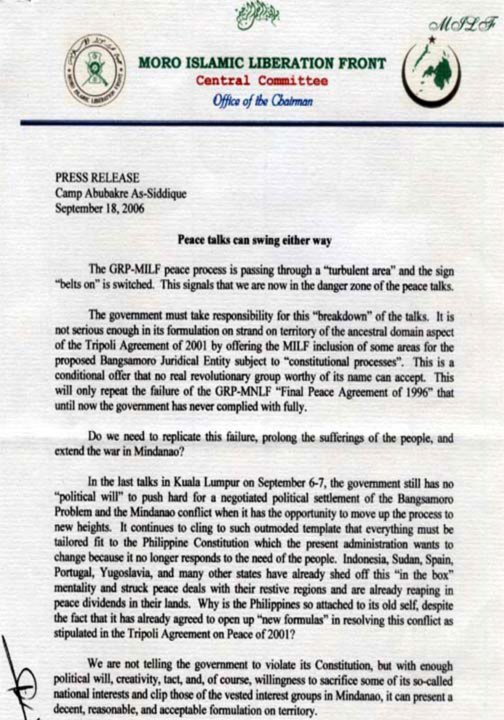
A copy of MILF statement sent Tuesday 19 Sept 2006 to the Mindanao Examiner. Above, MILF rebels chant "Allahu Akbar" which means God Is Great at a mountain base in Camp Abubakre As-Siddique in Maguindanao province. (Juan Magtanggol)

Monday, September 18, 2006

Don't Blame Us, Blame Manila For Break Down Of Peace Talks, MILF Says

(Mindanao Examiner Video)
A Moro Islamic Liberation Front member reads the Koran, a daily routine among the fighters of the country's largest Muslim rebel group. (Juan Magtanggol)

MAGUINDANAO (Juan Magtanggol / 18 Sept) The Philippines’ largest Muslim rebel group, Moro Islamic Liberation Front, warned Monday that Manila should be blamed if the peace talks fail after both sides ended a negotiation in Malaysia without any agreement.

Manila began peace negotiations with the MILF in 2001, but no major accord has been signed by both sides, except for a cease-fire agreement. And many rebels are slowly losing their patience on the five-year old peace talks.

Murad Ebrahim, the MILF chieftain, said the talks are now passing “a turbulent area” and that the Filipino government must take responsibility for the breakdown of the negotiations.

“This signals that we are now on the danger zone of the peace talks,” Ebrahim said, referring to the failure of the negotiations on Sept. 9 held in Malaysia, which is brokering the peace talks.

The MILF has rejected Manila's offer for a limited autonomy in the mineral-rich, but restive Mindanao island, home to about 4 million Muslims who want a separate Islamic state.

Mohager Iqbal, the head of the MILF peace panel, said the Philippine government offered them the 5-province Muslim autonomous region and 613 other Muslim villages in exchange for a peace deal.

"They offered the MILF the whole of the Muslim autonomous region and 613 other Muslim villages scattered in Mindanao, but all these are subject to Philippine legislation. The offer is just like a leopard skin and we did not agree with it."

"Peace cannot be unilaterally imposed on the MILF and the Muslim people," Iqbal told the Mindanao Examiner.

The Muslim autonomous region is composed of Lanao del Sur, Maguindanao, Basilan, Sulu and Tawi-Tawi -- which are among the poorest in the country torn by strife and clan wars since its creation in 1989.

The MILF previously proposed that the Muslims be given an option to choose in a referendum whether they wanted Mindanao to be an independent state or not.

Peace talks ended with both sides failing to sign any agreement on the most contentious issue -- ancestral domain -- which refers to the MILF demand for territory that will constitute a Muslim homeland. It is the single most important issue in the peace negotiations before the rebel group can reach a political settlement.

"The peace talks ended with nothing, but conditional offers from the Philippine government which we cannot accept," Iqbal said, adding, the Filipino President Gloria Arroyo has lack political will to resolve the decades old problems in Mindanao. "GMA lacks the political will to resolve the Mindanao problems." GMA refers to Gloria Macapagal Arroyo.

Ebrahim also said that offer was unacceptable to the Muslims. “This is a conditional offer that no real revolutionary group worthy of its name can accept,” he said.

The official Philippine News Agency said Manila will present to the MILF a new proposal aimed at resolving the ancestral domain issue hounding peace talks between both camps.

Executive Secretary Eduardo Ermita earlier said the peace talks are far from totally collapsing since negotiators will discuss what communities with Muslim-dominated population can be included in the so-called Bangsamoro homeland.

But for the MILF, the quest for peace is important to all Muslims in Mindanao. "There is no template for peace and what we need is a political settlement in Mindanao to bring development to the land we call home," Iqbal said.

The government previously announced that it was to sign a peace deal with the MILF by September or before the start of Ramadan, Islam's holiest month, but Iqbal said this is unlikely after both sides failed to agree on issues on ancestral domain and how the government and the rebel group would share natural resources in Mindanao.

Iqbal said the peace panels are likely to resume peace talks again before end of this month to discuss the ancestral domain. "The peace panels are likely to meet again before September 30 in Malaysia to discuss again the contentious issue of ancestral land. We don't expect a peace deal soon unless the Philippine government settle the issue of ancestral domain," he said.

Iqbal said the MILF has submitted its proposal to the government peace negotiators, but they disagreed on the scope of coverage of the Muslim ancestral domain. "There are still some contentious issues and these are the scope of Muslim territories under the ancestral domain and how the government and the MILF would share the resources in these areas," he said.

The ancestral domain covers the five Muslim autonomous provinces of Basilan, Sulu, Tawi-Tawi, Lanao del Sur and Maguindanao. And other areas in Zamboanga del Norte, Zamboanga del Sur, Zamboanga Sibugay, North Cotabato, Sultan Kudarat and Sarangani provinces where there are large communities of Muslims and indigenous tribes.

The MILF previously said it is willing to compromise if only to arrive at an acceptable, reasonable and comprehensive agreement that would include not only the Muslims, but all 18 ethnic tribal groups in Mindanao. Once an agreement is reached on how the MILF can govern these areas, government and rebel peace negotiators would finally discuss the political settlement of the country's longest-running Muslim insurgency problem.

Iqbal said Malaysia may pull out its cease-fire observers in Mindanao if the peace talks collapse. "Malaysia may recall all its cease-fire observers deployed in Mindanao if the peace talks totally collapse. That is the implication if the peace talks fail and Malaysia has implied this clearly to the MILF and the Philippine peace negotiators," Iqbal said.

The 60-man Malaysian-led international truce observers are deployed in Mindanao since last year to monitor the truce between MILF rebels and government forces.

Peace talks between the government and MILF started in January 1997 but the absence of a neutral third party bogged down the initiative. It was only on March 24, 2001, after the all-out war against the MILF declared by former President Joseph Estrada that Malaysia, at the behest of the Philippine government, facilitated the talks.

However, in February 2003, despite the avowed all-peace policy of President Arroyo, an all-out war was again declared against the rebels, but both sides later agreed to resume peace talks. Just this year, President Arroyo said that 80% of the peace talks have been completed and that permanent peace in Mindanao is within reach.

Ebrahim said the MILF will continue the peace talks, but warned the government that the rebel group would side with the Muslims should they decide on other means to continue their struggle for freedom.

“For the MILF, negotiation is still the best option to resolve the conflict in Mindanao. We have already spent so much time, efforts and resources for this,” Ebrahim said. “However, if the government insists to dilly-dally and treat the peace talks as mere counterinsurgency tool, who can blame the Bangsamoro people if they choose other means to continue their legitimate struggle for freedom and self-determination? For the MILF, we will stand by our people.”

Davao Hosts Civil Society Groups Forum

This summary is not available. Please click here to view the post.