Showing posts with label Subanen. Show all posts

Tuesday, December 11, 2007

Grant Us Our Ancestral Domain, Tribal Leader Asks

KABASALAN, Zamboanga Sibugay (Mindanao Examiner / Dec. 11, 2007) – A tribal leader said granting the indigenous people’s legitimate claims for their ancestral domain would be an effective tool for empowerment.

Wilfredo Sanggayan, an indigenous people (IP) representative to the Sangguniang Panlalawigan (Provincial Legislative Council) of Sibugay province, said the other way of looking at the several ancestral domain claims is to view it as a tool of empowering the indigenous peoples.

Sanggayan is the first Lumad representative to the Sangguniang Panlalawigan nationwide.

Zamboanga Sibugay is also the first province throughout the country to have IP representative to the Sangguniang Panlalawigan. Compostela Valley province is second.

“By granting the indigenous peoples their legitimate claims for their ancestral domains is to allow them to manage and govern themselves,” Sanggayan said.

Some 35 tribal leaders last week appealed to the concerned government agencies “to respect their legitimate claims of ancestral domain in this region.”

In a recent assembly held at the Ateneo de Zamboanga University, these tribal leaders also slammed what they called government “discrimination” against the rights of the Subanons in the peninsula.

The tribal conference dubbed “Glumpuk Nog Kobogolalanan Sog Pigsungan Nog Nawan (Assembly of Tribal Traditional Leaders of Zamboanga Peninsula) was part of the activities for the Mindanao Week of Peace, which started on November 29 and ended on December 5.

Early this month, Subanons from the three villages of Zamboanga City staged protest actions before government centers here.

“Our ancestral land is our kingdom where we have the chance to self-governance,” Sanggayan said, adding that part of his priority initiatives as Lumad representative to the provincial board is to undertake the titling of some 14 identified ancestral lands in Sibugay.

The provincial office of the National Commission of Indigenous Peoples (NCIP) also held a seminar here last week about the rights of the IP to ancestral domains.

Margarita Baya, officer-in-charge of NCIP provincial office, said “we need to help the Lumad in reclaiming their lands.”

“Gani, dili na yutang kabilin ang gusto nato bawi-on kundili yutang nabilin (In fact, it is no longer the ancestral land that we wanted but just a portion of that land),” Baya told this writer in jest.

There are four ancestral domain claims that are now pending at NCIP. These claims are from the towns of Siay, Naga, Roseller T. Lim, and Kabasalan, comprising at least 80,000 hectares of land of the province.

Another priority initiative that will benefit the indigenous peoples in the province, according to Sanggayan, is the establishment of Sibugay Indigenous Peoples Economic Zone Cum Indigenous Park and Living Museum.

“But as of now, we are now working for the recognition of Lumad representatives to the 14 local Sangguniang of the province,” Sanggayan said.

Fourteen of the 16 towns of this province need Lumad representatives to the local Sangguniang as mandated by Republic Act 8371, also known as “The Indigenous People's Rights Act of 1997”, according to Sanggayan.

RA 8371 mandates that “indigenous peoples shall be represented in all Sangguniang at all levels whose representatives shall be selected in accordance with the customs and traditions of the indigenous people concerned.”

Signed into law on October 29, 1997 by then President Fidel Ramos, the IPRA underwent many years of legislative study and deliberation before it became a law.It is the result of various consultations, consolidated bills related to ancestral domains and lands, and international agreements on the recognition of land/domain rights of the IPs.

In general, the IPRA seeks to recognize, promote and protect the rights of the IPs. These include the Right to Ancestral Domain and Lands; Right to Self-Governance and Empowerment; Social Justice and Human Rights; and the Right to Cultural Integrity.

Sanggayan pointed out that 14 of the 16 towns of Sibugay are inhabited by indigenous peoples with the Subanen tribe as the largest group.

The Subanen numbered around 1.3 million as of 2000 census scattered mostly in the provinces of Zamboanga Sibugay, Zamboanga del Sur, Zamboanga del Norte, Misamis Occidental, and Zamboanga City.

At present, according to Sanggayan, there are 11 local government units who had passed an ordinance recognizing the indigenous representatives to their respective Sangguniang Panlalawigan.

“But only seven of the 11 have formally accepted and installed an IP representative as a member of their local councils,” Sanggayan, who earned the distinction as the first IP representative to the Sangguniang Panlalawigan throughout the country, lamented.

”We will continue to reiterate our request to the different local government officials concerned concerning the representation of the indigenous people in the council as mandated by RA 8371,” Sanggayan said. “We are only asking what is due us.” (Antonio Manaytay)

Wednesday, November 29, 2006

Siocon Subanon Association Has New Set Of Officers


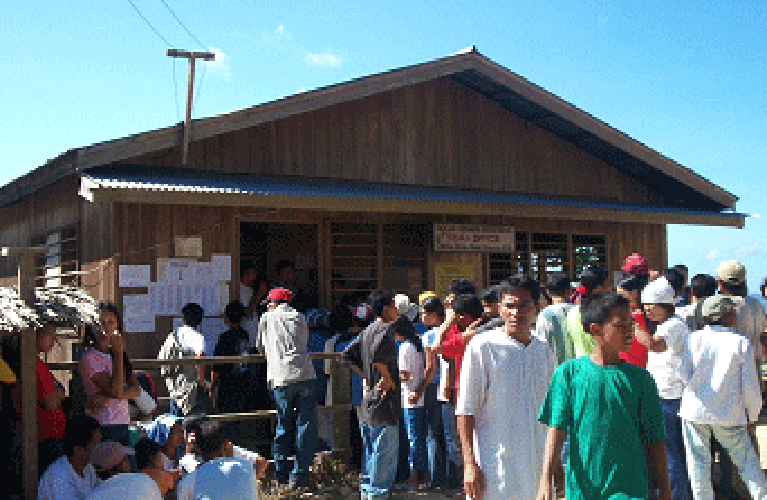
Subanon democracy in action. The Siocon Subanon Association, Inc., in Zamboanga del Norte province elects new set of officers.

ZAMBOANGA DEL NORTE (Rocky Dimaculangan / 29 Nov) – An indigenous Subanon tribe in a remote mountainous ancestral land in Southern Philippines has shown its readiness for self-determination after its members successfully elected a new set of leaders who promised to spearhead community efforts to attain sustainable development in partnership with a foreign-funded mining company.
The Siocon Subanon Association, Inc. (SSAI) – legal representative of the Certificate of Ancestral Domain Title holders (CADT) of Canatuan in Barangay Tabayo – held its biennial election of officers Nov. 25 with the participation of the overwhelming majority of association members. The elections, described as peaceful and honest, were sanctioned and observed by representatives of the National Commission on Indigenous Peoples (NCIP).
Patoh prevailed over incumbent SSAI President Juanito Tumangkis with a margin of 337 votes. Patoh and Tumangkis garnered 619 and 282 votes, respectively.
Danilo Bason, Patoh’s running mate, bagged the vice presidential slot after besting Rufino Sapian. Alfredo Limbang, meanwhile, ran unopposed as treasurer.
Also elected as members of the SSAI Board of Trustees are: Lydia Dandana, Pasing Bason, Zenaida Dandana, Danilo Tumangkis, Sr., Santiago Sumampang, Alberto Mais, Paho Fuentevilla, Yolanda Lacaste-Santos, Andres Ansani, Celestino Guinagag, Pancho Tumangkis, Sr., and Erdulfo Comisas. According to the Election Committee (ComElec) – chaired by SSAI member Chirino Limpuson and with members from indigenous people (IP) communities in nearby towns and provinces – 1,032 votes were cast out of the 1,341 registered number of voters.
A total of 131 ballots were declared invalid or abstained in the presidential race. Observers say Patoh’s lopsided victory came after an increasing clamor for the immediate conduct of elections had been noted from direct and indirect CADT beneficiaries in recent months.
It was learned that the SSAI elections were overdue by a year – and Chairman Tumangkis appears to have suffered the same electoral fate as that of many incumbent leaders around the world! Direct beneficiaries are IP CADT holders whose claims are within the 508-hectare area of TVI Resource Development Philippines Inc.’s Mineral Production Sharing Agreement (MPSA) with the Philippine government; they are eligible to run for office.
Indirect beneficiaries, on the other hand, have claims outside of TVIRD’s MPSA area; while they can vote, they cannot assume elective posts in SSAI. TVIRD is the first foreign-funded resource development firm to reach production stage after the passage into law of the Philippine Mining Act of 1995.
Its international affiliate, TVI Pacific Inc., is listed in the Toronto Stock Exchange (TSX:TVI). Nine officials from the NCIP were present during the elections as observers. They were joined by Ms Hanayo Hirai, a Japanese national connected with United Nations Children’s Educational Fund (UNICEF).
ComElec Chairman Limpuson said the elections were generally honest and clean. There were minor accusations of election irregularities – but these are a common, rather expected complaint, especially from defeated candidates in these islands, he said.
Shortly after the canvassing of votes that lasted until the wee hours of November 26, Patoh and the other winning candidates were proclaimed by the ComElec in the presence of NCIP observers headed by Masli Quilaman, Director of the Office on Empowerment and Human Rights at the NCIP Central Office, as well as of voters and supporters who stayed on to guard their votes and until the last ballot was countedThe newly elected SSAI officials will take their oath of office on December 1.
They were congratulated by the TVI Board of Directors headed by CEO Cliff James during their visit to the Canatuan Project last November 26. “Democracy has prevailed in our host community,” Eugene Mateo, TVIRD President, said after learning of the results of the elections.
“I hope our Subanon brothers and sisters who ran under opposing camps will be able to immediately set aside the differences that may have been created along the campaign trail."
"I also hope they can sit down together and begin the more important task of charting and working towards a sustainable future for the citizens of Canatuan in partnership with TVIRD. We offer our best wishes to SSAI’s new officers, as well as for the continued success of our partnership for development.”
In 2005, TVIRD paid SSAI royalty equivalent to 1% of the Company’s gross revenues amounting to over P5 million, net of final tax. From January to September this year, royalty payments have reached above P10 million, and is estimated to increase to P14 million, net of tax, at yearend.
Under the Memorandum of Agreement for the development of Canatuan forged between SSAI and TVIRD, the Company has no influence over how the IPs will invest their royalty. Also in accordance with the MOA, TVIRD has embarked on various socio-economic and environmental protection initiatives for its Subanon hosts.
These initiatives include the construction of schoolhouses and health clinics, the improvement of roads and the facilitation of the building of bridges, the setting up of livelihood programs, as well as the planting of over 50,000 trees and the erection of a P170 million Gossan Tailings Dam.
TVIRD and SSAI have began laying the groundwork for the Tanuman Settlement Project, a component of the Mine Rehabilitation Plan which provides for an independent Subanon Village complete with water supply, sanitation and power facilities.
Elements of the Philippine Army’s 44th Infantry Battalion and the Philippine National Police, both based in Siocon town, provided security to the Subanon of Canatuan while they exercised their sacred right to vote.