Showing posts with label US. Show all posts

Friday, October 10, 2008

US Opens Door To Philippine Mango Products

ZAMBOANGA CITY, Philippines (Mindanao Examiner / Oct. 10, 2008) – The Philippines’ Bureau of Plant Industry said the United States is looking for suppliers that could provide sufficient importations of mango fruit products.

Dr Hernani Golez, BPI’s program coordinator, said the US market has opened its door for importations of mango products that will come from the Philippines. But mango products bound to the US are expected to pass a tight quality control, he said.

He said that BPI will conduct a series of survey in Zamboanga City and other areas in the southern Philippines which are known to produce mango products.

“There will a series of consultations and seminar with the stake holders to educate them on the proper way of growing mango and modern techniques that will help them in their farm,” he said.

Golez said the US market is very strict on the compliance of requirements that will commensurate with its high quality standards on food.

“One of the requirements is that the mango should be free from pests such as the so called seed and pulp weevils which are rampant in many mango farms in the country,” he said.

Golez said these problems will be one of their concerns on the conduct of the survey.

To address the problems, Golez said the Department of Agriculture will adopt measures to ensure the quality of the fruit will pass the standards of the US market and to provide greater access for the country's mango products. (Erico Rosco)

Sunday, April 20, 2008

Photo: Sulu Province (Jolo Island)


Ferries are anchor at the port of Jolo in the southern Philippine province of Sulu. The United States has committed millions of dollars for the rehabilitation of the port and the airport in Sulu, says Governor Sakur Tan. A few hundred American soldiers are currently stationed in Sulu, on the request of the Philippine government, to help train local troops and carry out humanitarian and development projects in the province. And a small motorized boat just off the coastal town of Jolo. (Mindanao Examiner Photo)

Saturday, January 26, 2008

Exodus Of Pinoy Nurses Continue

MANILA, Philippines (Mindanao Examiner / Jan. 26, 2007) - More than 21,000 new Filipino nurses sought employment in the United States last year and the exodus continue, draining the country of much needed hospital professionals.

The Trade Union Congress of the Philippines (TUCP) said a total of 21,499 Filipinos took the US National Council Licensure Examination (NCLEX) for nurses for the first time -- excluding repeaters -- from January to December 2007.

This represents an increase of 6,328 or 42 percent compared to the 15,171 Filipinos that took the NCLEX for the first time in the whole of 2006, TUCP spokesperson Alex Aguilar, said.

He said the 2007 NCLEX statistics, released Jan. 24 by the US National Council of State Boards of Nursing (NCSBN), only shows the Philippines' position as America's top provider of foreign nurses.

Aguilar said the Philippines readily topped the five countries with the most number of nationals taking the NCLEX for the first time in 2007. India came second, with 5,370 examinees; followed by South Korea, 1,906; Canada, 888; and Cuba, 673.

Passing the NCLEX is usually the final step in the nurse licensure process in the US. Thus, the number of people taking the examination is a reliable indicator of how many new US-educated as well as foreign-trained nurses are trying to enter the profession in the US.

TUCP's disclosure came a day after the Philippine Overseas Employment Administration (POEA) expressed confidence that global demand for Filipino workers would remain robust despite fears of an economic slump in the US.

Many foreign countries, particularly the developed ones, are still approaching the Philippines wanting to recruit Filipino workers, particularly professionals and other skilled personnel, POEA chief Rosalinda Baldoz said.

"Foreign employers come to us because they are short of capable workers and their nationals refuse to handle the dirty, dangerous and difficult jobs," Baldoz said.

Even in the US, where there are fears of a looming recession, Baldoz said they see a growing demand for nurses as well as temporary workers in hotels.

Buoyed by record high crude oil prices, Middle Eastern countries also need thousands of foreign workers to support heightened economic activity in that part of the world, she added.

The TUCP has been pushing the deployment of surplus nurses and other highly skilled workers to lucrative job markets overseas.

"Our sense is, if we must advance the export of services, we might as well consciously encourage the deployment highly skilled surplus professionals such as nurses, who are generally immune from employer mistreatment," Aguilar said.

He said the government should "purposely discourage" the overseas deployment of unskilled workers such as domestic helpers. "Their skills are easily replaceable. This is why they are undeniably far more susceptible to employer abuse," he added.

Aguilar said Filipino nurses looking for greener pastures could definitely count on greater employment opportunities in the US, where more than 800 new hospitals would be put up until 2012.

He said some 78 million American baby boomers -- those born between 1946 to 1964 -- now comprise 26 percent of the 300-million US population. The oldest baby boomers started turning 60 years old in 2006, he added.

"These seniors and the deluge of migrants from Mexico are creating a huge demand for hospitalization and health care in the US," Aguilar pointed out.

Aguilar played down fears of a brain drain with the continuing deployment of Filipino nurses to overseas labor markets.

"We are now producing nurses at a rate of 100,000 to 150,000 every year, and less than five percent of them are getting employed locally, either by the government or the private sector. So we definitely have a large surplus of nurses," he said.

Just last August, he noted that the Professional Regulation Commission (PRC) admitted to the local nursing profession a total of 31,275 candidates who passed June 2007 licensure examination.

This does not include the thousands of candidates who took the December 2007 nursing eligibility examination, the results of which will be released soon.

On top of those who took the December examination, the PRC earlier said it expects anywhere from 80,000 to 100,000 nursing graduates to take the June 2008 licensure test.

Meanwhile, TUCP renewed its objection to a House bill that seeks to require nurses who obtained government-subsidized schooling to render at least two years of compulsory local service before they can leave for overseas employment.

The labor group was referring to a bill that seeks to oblige nursing graduates of state colleges and universities to perform 24 months of mandatory service here before they may be lawfully recruited to work abroad.

Aguilar said the bill was "totally counterproductive and uncalled-for," considering the massive oversupply of nurses in the local labor market.

Sunday, November 11, 2007

Estados Unidos Nagpahayag Ng Suporta Sa Mindanao Peace Process

MAGUINDANAO (Mindanao Examiner / Nov. 11, 2007) – Nagpahayag ng suporta ng Estados Unidos sa peace process sa pagitan ng pamahalaang Arroyo at Moro Islamic Liberation Front (MILF).

Sa katunayan ay mismong si Paul Jones, isa sa mga mataas na opisyal ng embahada ng Estados Unidos, ang nakipagkita kay MILF chieftain Murad Ebrahim kamakalawa sa isang kampo ng mga rebelde sa lalawigan ng Sultan Kudarat.

Inamin naman ito ng MILF at sinabing maganda ang naging paguusap ng dalawa at Sinabi rin ni Jones na patuloy ang suporta ng kanyang bansa sa peace process sa Mindanao.

Isa ang Estados Unidos sa mga bansang nagbubuhos ng malaking pondo sa Mindanao upang maisulong ang kaunlaran ng rehiyon. Karamihan sa mga pondong ito ay naipagpagawa ng mga kalsada at daungan, patubig at kuryente at maraming iba pa.

Naunang nag-alok ang Estados Unidos ng $30-milyon upang pondohan ang iba pang mga proyekto kung magkakaroon ng kasunduan ang pamahalaan at MILF.

Kasalukuyang may peace talks ang dalawang grupo at naniniwala ang pamahalaan na magkakaroon ng resulta ito bago magtapos ng kanyang termino si Pangulong Gloria Arroyo sa 2010. (Mindanao Examiner)

Monday, October 01, 2007

US Hands Over New Projects In Southern Philippines

ZAMBOANGA CITY, Philippines (Mindanao Examiner / Oct. 01, 2007) – The United States on Monday handed over two infrastructure projects worth more than P150-million to Filipino officials in the southern island of Basilan.

American Ambassador Kristie Kenney led officials in the ceremony held in the towns of Maluso and Lantawan.

The projects, a port area in Maluso and a bridge in Lantawan towns, were constructed under the US Agency for International Development-Growth with Equity in Mindanao.
Security was tight throughout Kenney’s visit in Basilan, where Filipino security forces are still hunting down Abu Sayyaf militants, blamed for a recent attack that killed two soldiers and wounded over a dozen others in Basilan’s Tipo-Tipo town.

Kenney last week also handed over $3.7 million of development projects in Sulu province on top of the $190 million grant aid to Mindanao.

The $3.7 million will be used for the repair of the Jolo airport and the construction of a potable water system in Sulu.

Aside from the funding, Kenney also handed over to local officials the P27-million Jolo market road and several projects in the province, including computers for the Sulu National High School and aquaculture materials for former Moro rebels now engaged in lobster fattening. (Mindanao Examiner)

Thursday, September 27, 2007

US, RP Move Supplies, Infra Equipment In Sulu


A US convoy transporting supplies and equipment for infrastructure passes Thursday 27 Sept, 2007 through a village in Indanan town in Sulu province in southern Philippines. Washington has poured $3.7 million in development projects in Sulu to help in Manila's peace efforts. Sulu Gov. Sakur Tan said the money will be used for the repair of the Jolo airport and the putting up of a potable water system in the province. Last month, the US signed a $190 million grant aid for various infrastructure projects in Mindanao island. (Mindanao Examiner Photo Service)


SULU ISLAND, Philippines (Mindanao Examiner / 27 Sept) – US and Filipino soldiers deployed in Sulu have began moving supplies and equipment for infrastructure projects on Thursday as more countries pledged to help develop the southern Philippine province.

The soldiers were spotted passing in the town of Indanan in several trucks and jeeps transporting equipment to the delight of the locals. “We have projects to do here…for the people,” one Filipino soldier yelled as their truck headed to Indanan.

Hundreds of US troops are stationed in Sulu and helping Filipino soldiers carry out humanitarian missions on the request of the Philippine government. The US is also training local troops in anti-terrorism warfare.

Sulu Gov. Sakur Tan said some countries, including Syria, have expressed to help in peace and development projects in the province.

“We welcome all assistance and aid from donor countries and international nongovernmental organizations to promote peace and development in the region,” he told the Mindanao Examiner.
Tan did not say what other countries have pledged to help Sulu, but on Monday the United States and Britain unveiled a huge package of development projects in the province in an effort to help Manila bring peace and progress in the region.

Ambassadors Kristie Kenney, of the United States, and Peter Beckingham, of the British Embassy, arrived in Jolo town and announced a $3 million funding for the repair of the local airport and the installation of a $700,000 potable water system in Sulu.
Tan said the US and British projects will help a lot of people in Sulu, one of five provinces under the Autonomous Region in Muslim Mindanao.

It was on top of the $190 million development and economic growth agreement the US signed last week to help fund other projects in Mindanao. (Mindanao Examiner)

Thursday, September 20, 2007

U.S. Signs $190 Million Mindanao Peace Aid

MANILA, Philippines (Mindanao Examiner / 20 Sept) – The United States and the Philippines signed a $190 million grant aid to help sustain peace and development efforts in the restive region of Mindanao, where security forces are battling Muslim and communist insurgencies for decades now.

Called the Mindanao Peace and Development (MPAD) assistance, the aid is a five-year joint effort of the Philippine government and the United States which aims to develop the needed infrastructure, improve governance and social services as well as expand the economic opportunity in vulnerable and conflict-affected areas in Mindanao.

President Gloria Arroyo, together with US Ambassador Kristie Kenney and Augusto Santos, OIC-Director General of the National Economic Development Authority, witnessed the signing of the agreement Wednesday between Undersecretary Virgilio Leyretana, chairman of Mindanao Economic Development Council and Jon Lindborg, USAID-Philippines Mission Director.

With the continuation and expansion of the USAID assistance, MPAD is projected to sustain the gains of peace and development that have been achieved so far in Mindanao and widen the scope of social and economic infrastructures and services to a larger Mindanao populace.

“MPAD will enable us to achieve growth with equity and parity as well as accelerate the social and economic inclusion of Mindanao into the BROAD spectrum of national affairs,” Leyretana said in a statement sent to the Mindanao Examiner on Thursday.

Security forces are battling insurgencies in Mindanao the past four decades and fighting have significantly stalled development of the region, now slowly becoming a breeding ground for terrorists where Abu Sayyaf and Jemaah Islamiya are threatening Manila’s peace efforts.

Monday, August 20, 2007

Bush Seeks To Boost Canada, Mexico Ties: AP

OTTAWA - President Bush, tending to relations with two border nations, will try to give a boost Monday to his partnerships with the like-minded leaders of Canada and Mexico.

Bush's two-day summit with Canadian Prime Minister Stephen Harper and Mexican President Felipe Calderon is the third of its kind during his presidency.

Each one has been meant to bolster an evolving compact — dubbed the Security and Prosperity Partnership of North America — that serves as a way for the nations to team up on health, security and commerce.

Yet for Bush, the event also allows him to show he does not take his neighbors for granted; they are both vital trading partners and energy providers for the U.S.

"The message for Canada and Mexico is that despite the ongoing emphasis on Iraq and terrorism in U.S. foreign policy ... the U.S. is investing time and attention on relationships with our own region," said Chris Sands, a scholar of North American studies and senior associate at the Center for Strategic and International Studies.

The partnership of the countries is a framework for working out problems — not a deal that was ever intended to produce dramatic announcements. None are expected at the summit.

Personally, Bush shares plenty of views with Harper and Calderon, two fellow conservatives and free-market advocates who have come into power during his second term.

It's not all cheery. The summit is drawing protests from critics of Canada's troop presence in Afghanistan and of the partnership among the three countries. Some Canadians see it as an insidious threat to their sovereignty, led by the United States.

Police were out in force Sunday in Ottawa, where protests began even before Bush was to arrive Monday from his ranch in Crawford, Texas. The summit itself will take place about 50 miles to the east at a luxury resort in Montebello, Quebec, where security is even tighter.

The broad theme of the summit is economic prosperity, built around several topics: border security, competitiveness with India and China, product safety and energy solutions.

Bush will also be faced with matters of specific concern to each of the countries.

He will first meet with Harper at Fairmont Le Chateau Montebello, a luxury resort made out of one of the world's largest log cabins.

Bush is sure to thank Harper for Canada's commitment to keeping troops in Afghanistan.

Meanwhile, Harper is frustrated over a U.S. law that tightened passport rules for Canadians visiting the U.S., although Bush has pledged to enforce it and has little leeway.

Harper is also expected to assert his nation's claim to the fabled Northwest Passage through the resource-rich Arctic. Competition to control the Arctic has intensified with global warming; Russia sent two small submarines to plant a tiny national flag under the North Pole this month. The U.S. and Norway also have claims.

Bush and Calderon will have their own one-on-one session later Monday.

With them, the messy issue of immigration looms large. The last time these two leaders met, in March in Mexico, Bush was optimistic about getting a new immigration law.

Since then, his plan died in Congress.

So Bush recently issued an executive order meant to tighten border security, streamline guest-worker programs and pressure employers to fire illegal immigrant workers.

The U.S. government has been working on a major aid package to help Calderon fight drug trafficking in Mexico. The deal may be announced in part or in whole at the summit.

The three leaders will join at day's end for dinner, then resume talks Tuesday.(AP)

Sunday, July 08, 2007

US Pours More Funding To Fight Terrorism In Philippines

MANILA (Mindanao Examiner / 08 Jul) - Washington has poured more military funding in the Philippines to help the Arroyo government fight terrorism and insurgency in the volatile southern region, where hundreds of U.S. troops are currently stationed.

The Philippines praised Washington and U.S. lawmakers for appropriating a $30-million foreign military funding to the help fight terrorism and bring lasting peace and progress in the troubled southern region of Mindanao.

Troops, backed by U.S. military intelligence, are battling Abu Sayyaf and Jemaah Islamiya terrorists and Maoist insurgency in the southern Philippines.

The U.S. recently delivered 20 ageing UH-1H Huey helicopters for the Philippine Air Force and promised more in the next few years.

Press Secretary Ignacio Bunye said the $30-million was appropriated under the 2008 Foreign Military Funding bill by both Houses of the US Congress.

"We are thankful to our friends in both Houses of the US Congress and in the Executive Branch for their faith in the government of the Philippines as demonstrated in the strong military funding currently appropriated to the Philippines in the 2008 Foreign Military Funding bill," Bunye said in a statement.

"We share mutual determination to bring peace and solidarity in Mindanao and to strengthen US-Philippines security relations," he said.

Bunye said US funding has been very helpful to the fight against terrorism and in bringing in basic infrastructure, education, and health care in crucial areas in Mindanao.

"This is funding that has allowed our partnership with the United States to break new ground in making our country and our region safer from the threat of terror. This is funding that has saved lives and that has brought renewed hopes of lasting peace and meaningful progress to thousands," Bunye said.

The US Congress also approved an additional $2 million subject to the confirmation of the State Department that the Philippines is implementing the recommendations of the United Nations Special Rapporteur on Extra-judicial, Summary or Arbitrary Executions.

Militant groups and political activists in the Philippines blamed the military as behind more than 900 extra-judicial killings in the country since President Gloria Arroyo took power in 2001.
The Philippine military denied the accusations.

"We see this provision as a sincere desire to help and further encourage the Philippines to address the issue of politically-motivated killings. We assure the members of the US Congress that the Philippine government acknowledges their concern and see this as a sincere desire to help us address the issue," Bunye said.

Washington also promised addtional $30-million in aid once a peace accord is reached between the Philippine government and the country's largest Muslim rebel group, the Moro Islamic Liberation Front. (Mindanao Examiner)

Friday, June 01, 2007

"Dirty Harry" Rejects Plans To Hold RP-US Anti-Terror Warfare In Davao

Davao City Mayor Rodrigo Duterte. (Photo by CPJ.Org)


DAVAO CITY (Mindanao Examiner / 1 June) – A Southern Philippine mayor on Friday rejected government proposal for U.S. and Filipino troops to hold joint anti-terror training in the port city of Davao.

Rodrigo Duterte, the city’s mayor, said the training would put Davao on the list of possible terrorist target and warned that any attempt to pursue the plan could attract more attacks from anti-American militants and communist insurgents.

Duterte said he would not allow Davao City as venue of any war games between Filipino and American soldiers. He said a senior government official phoned him about the proposal to bring the training to Davao City.

"If troubles erupt, I will wash my hands," Duterte, known as the “Dirty Harry” of the Philippines, said.

Dirty Harry is a 1971 film directed by Don Siegel. Clint Eastwood played the title role, in his first outing as San Francisco Police Department Inspector "Dirty" Harry Callahan.

Callahan's nickname, "Dirty Harry," is a reference to his reputation for taking on the "dirtiest" cases and resolving them even if it involves the violation of criminals' rights.

"The mere presence of U.S. soldiers is like a magnet for terrorists,” Duterte said. (Romy Bwaga)

Wednesday, March 14, 2007

RP's Progressive Groups Appeal To Yanks For Help

DAVAO CITY - Progressive group Suara party list on Wednesday called on all US citizens to pressure their government on the tenacious incidents of extrajudicial killings in the Philippines, a country that receives millions of dollars-worth of financial assistance from the American government.

This, as Bayan, the largest among progressive groups in the country, also sounded the call for the US Congress to stop supporting the Philippine government with financial aids as it continues to show its inutility in solving the killings of militant leaders and members, students and journalists now numbering close to a thousand since 2001, the year when Gloria Macapagal-Arroyo became president.

Abubakar Uy, secretary general of Suara-Southern Mindanao, said Americans, who are fighters of freedom and democracy, can actually press their own government to stop supporting the Philippines’ security agents who are blamed for the series of killings.

“Americans must realize that the money they giving their government in the form of tax are now used to finance the slaughter of hundreds of Filipinos. They must realize that they are actually supporting the evil desires of a criminal government which is out to murder all of those whom it consider enemy as it desires to stay in power,” Uy said in a statement sent to the Mindanao Examiner.

“So we appeal to all Americans to ask the US government suspend its financial aids to a country like the Philippines…a country that is hell-bent in murdering hapless civilians. While US aids continue to pour in to the country and finds its way into the military, deaths will never stop,” Uy said.

The United Nations human rights expert Prof. Phillip Alston and the Philippine-government backed Melo Commission which was tasked to investigate the series of killings, both agreed of the military’s culpability in the death.

The government has denied this. The US Congress will discuss next week the cases of killing in the country and Philippine officials have so far showed an image of confidence on the result of the investigation.

Immediately, Justice Secy. Raul Gonzales said the government will clear its name.

For Suara, the culpability of the government is so obvious already that it can never persuade anyone that it is not behind the killings. Although the idea of the US government investigating the cases of extra-judicial killings in the Philippines doesn’t sit well with progressive groups like Suara, the idea of the international community giving attention to human rights abuses happening in a democratic country like the Philippines is a welcome development.

“What is more important is for the people around the world to know that the Philippine government is killing its own people and if their government will pledge support to the Philippine government, it would only mean that they too supports the slaughter of the Filipino people,” Yap said.

Wednesday, January 17, 2007

More Troops Sent To Jolo To Fight Abu Sayyaf, Jemaah Islamiya Ahead Of Condoleezza Rice Visit


Western Mindanao military chief Lt. Gen. Eugenio Cedo inspects seized Abu Sayyaf bomb materials and munitions in Jolo island on Wednesday, Jan. 17, 2006. And the body of slain Abu Sayyaf leader, Jainal Antel Sali, Jr. alias Abu Solaiman. A Philippine Air Force helicopter gunner aims his machine gun over Bud Dajo in Jolo's Talipao town, where Solaiman was killed in fierce firefight with troops. (Mindanao Examiner Photos)


JOLO ISLAND (Mindanao Examiner / 17 Jan) – The Philippine military on Wednesday sent more troops to the troubled southern island of Jolo and vowed to crush the Abu Sayyaf group tied to al-Qaeda terror network and the Jemaah Islamiya.

A Philippine Air Force C130 cargo plane transported soldiers and weapons from Manila to help the hundreds of troops already in Jolo to fight the Abu Sayyaf.

The offensive began in August last year when the military launched a series of campaigns aimed at capturing or killing terror leaders, including two Jemaah Islamiya militants Dulmatin and Umar Patek, blamed for the spate of bombings and attacks on civilian and government targets.

Soldiers drove in a convoy of trucks and armored vehicles and unloaded munitions and rockets and caches of other armaments inside an army base in Jolo town, where a contingent of U.S. troops are stationed and helping the Philippine military defeat terrorism on the island.

The arrival of the troops came ahead of a planned visit in Jolo of U.S. Secretary of State, Condoleezza Rice. A highly placed government source said Rice, who had earlier served as National Security Advisor under President George W. Bush, would visit the island to inspect American troops before the start of new joint RP-US anti-terror exercises next month.

On Tuesday, Filipino troops, guided by U.S. military intelligence, raided an Abu Sayyaf hideout on Bud Dajo (also called Mount Daho) in Jolo’s Talipao town and killed a senior militant leader, Jainal Antel Sali, Jr. alias Abu Solaiman. A regional Filipino army spokesman, Maj. Eugene Batara said the death of Sali was big blow to the Abu Sayyaf.

Bud Dajo, an active volcano on the island, has a treacherous terrain, dangerous crevices and covered with thick canopy of trees, making it extremely difficult for air surveillance to track down the enemies.

“Let this be a warning to terrorists that there is no escape and we will get you, sooner or later. The Abu Sayyaf should surrender peacefully,” said Army Lt. Gen. Eugenio Cedo, the chief of the military’s Western Mindanao Command.

Cedo was in Jolo on Wednesday and inspected the body of Sali, the spokesman of the dreaded Abu Sayyaf group, believed to have masterminded many bombings in the southern Philippines.

A UH-1H Huey helicopter later flew Cedo and his commanders over Bud Dajo, where troops were tracking down about 60 Abu Sayyaf militants, who escaped Tuesday’s fighting.

Sali was buried Wednesday in Jolo after relatives and friends positively identified the body. A bullet fired by a soldier tore a hole on Sali’s chest. A piece of wood, about an inch long, embedded on his left cheek, was pulled out by two imams hired by the military to clean and bury the corpse in accordance with the Islamic tradition.

“It was him, alright. It was Abu Solaiman. His time finally has come and it’s the end of the road for Solaiman,” Karim Muktar, a former Muslim rebel-turned-government soldier, told the Mindanao Examiner.

But even after his death, some soldiers cursed Sali. “His soul is already in hell. Abu Solaiman was so notorious that many innocent people – men, women and children – died because of him,” one soldier, who gave his name only as William, said.

Sali was included in the U.S. list of most wanted Abu Sayyaf terror leaders and had been implicated in the kidnappings and killings of California man Guillermo Sobero in 2001 and Kansas missionary Martin Burnham in 2002.

Gracia Burnham was eventually rescued in 2002 by U.S. and Filipino soldiers after a firefight in Zamboanga del Norte province.
Sali, 41, was also linked to the kidnapping of U.S. citizen, Jeffrey Craig Schilling, in 2000 when he visited Jolo island with his Filipino girlfriend.
Schilling was held hostage for more than seven months by the Abu Sayyaf and during his captivity, some of the demands made by the Abu Sayyaf were the release of international terrorist Ramsey Yousef and the blind Muslim cleric Sheik Omar Abdel Rahman from U.S. prison, the withdrawal of American forces from the Middle East and the payment of $10 million in ransom. Schilling eventually managed to escape from captivity on April 12, 2001.

A U.S. government dossier on Sali, a native of Basilan island, said he had planned and perpetrated several brutal acts of terrorism involving kidnapping U.S. and foreign nationals and bombing civilian targets.

In April 2004, Sali helped supervise members of the Abu Sayyaf's Urban Terror Group for planned bombing activities. Filipino authorities filed charges against Sali and two other leaders for their involvement in a series of bombings in October 2002 in Zamboanga City that killed at least a dozen Filipino civilians, an American soldier and wounding more than 200 others.
Sali also headed the unit responsible for the October 17, 2002, bombings of two department stores in Zamboanga City. He also planned the May 2001 Dos Palmas resort kidnapping in the central Philippine island of Palawan where they took 20 hostages, including Burnham and his wife, Gracia and Guillermo Sobero.
During the movement of the hostages in June 2001 by the Abu Sayyaf, two hostages, who were foreign national employees of the resort, were beheaded on Basilan Island.Sali's group along with 17 of the hostages then proceeded to Jose Torres Memorial Hospital in Lamitan town in Basilan island where they seized and detained additional hostages.
Later in June 2001, the Abu Sayyaf beheaded Sobero. In January 2002, Sali made statements during a radio interview denouncing the arrival of U.S. military advisors in the Philippines to participate in joint military exercises with the Armed Forces of the Philippines designed to locate and combat the Abu Sayyaf and rescue the hostages.
Sali held several senior positions of influence within the Abu Sayyaf. In February 2002, the U.S. indicted Sali and four other Abu Sayyaf leaders. Three years later, Sali accompanied Abu Sayyaf chieftain Khadaffy Janjalani and another senior leader Isnilon Hapilon to a meeting in the southern Philippines with senior leaders of Jemaah Islamiyah, an al-Qaeda-linked terrorist organization operating in Southeast Asia. The JI leaders included Dulmatin and Patek, who were both suspected of playing a role in the 2002 Bali bombings that killed 202 mostly foreigners.
The Abu Sayyaf group got its name from "Abu Sayyaf," meaning "Father of the Sword" or "Bearer of the Sword" in Arabic. The group is also known as Al-Harakat Al-Islamiyah, meaning "the Islamic Movement." Since 1997, the Abu Sayyaf has been designated by the State Department as a "foreign terrorist organization."
The group's written charter states, among other things that the purpose of the group is either to establish an Islamic government in the southern Philippines or to "reach Martyrdom in Allah 's way" and that the group considers jihad (holy war) "as the only method and alternative to stop and root out aggression, tyranny, injustice, and oppression." (Mindanao Examiner)

Monday, January 08, 2007

Arroyo Visits Jolo Island, Commends Troops For Successful Anti-Terror Ops


President Gloria Arroyo's visit to Jolo island Monday, 08 Jan 2007. (Mindanao Examiner)


JOLO ISLAND (Mindanao Examiner / 08 Jan) – Philippine President Gloria Arroyo on Monday praised soldiers for their successful operation against members of the al-Qaeda-linked Abu Sayyaf group and Jemaah Islamiya militants in Jolo island.

Arroyo visited the troubled island, about 950 kms south of Manila, under tight security. About 300 troops and policemen guarded the Filipino leader who inaugurated a $969,000 US-funded road project in Parang town and a hospital inside a military base in Jolo town. US Charge d'Affaires Paul Jones and Presidential peace adviser Secy. Jesus Dureza accompanied Arroyo.

A US EP3 reconnaissance plane was also spotted over Parang town, aside from a pair of Filipino MG-520 combat choppers. About a dozen local politicians arrived with armed escorts. Soldiers and policemen overwhelmed some 200 people invited in the inauguratin in Parang town.

Arroyo shook hands with the locals and briefly stopped to chat with some Muslim women. She also praised the US for its development projects in Jolo, a stronghold of the Abu Sayyaf.

Arroyo commended the soldiers for their courage in fighting the Abu Sayyaf and Jemaah Islamiya. She was also briefed by Armed Forces chief Gen. Hermogenes Esperon and Western Mindanao military commander Lt. Gen. Eugenio Cedo.

Soldiers killed at least 6 Abu Sayyaf members, including an Indonesian Jemaah Islamiya militant, in a fierce sea battle on Saturday off the southern island of Tawi-Tawi near the Sabah border.

Esperon on Monday said those killed were attempting to escape to Sabah. Troops attacked an Abu Sayyaf speedboat after it tried to escape from a sea blockade near Panglima Sugala town.

The boat’s passengers traded automatic gunfire with soldiers until they were all killed.

“I commend the Armed Forces of the Philippines for the successful operation against the Abu Sayyaf and the Jemaah Islamiyah, which only proves that these terrorist elements have nowhere to hide and are in fact already doomed to annihilation.”

“Our fight against terror goes hand in hand with the global and regional effort; and as we face the ASEAN summit, we would like to assure all our allies in East Asia and beyond that the Filipino soldiery and people are on watch every hour of the day, determined to do their share to defeat terror for a more secure and safer world,” she said.

Arroyo was referring to the 12th Association of Southeast Asian Nations (ASEAN) Summit set to be held in the central Philippine island of Cebu this week.
(Mindanao Examiner)


Monday, December 11, 2006

Photo: U.S. Helicopter Hovers On Jolo Island


A US helicopter, transporting American troops, hovers in Jolo island in the southern Philippines, where US soldiers are involved in humanitarian missions. (Mindanao Examiner)

Friday, October 20, 2006

Sayyaf Informant Gets Reward Money

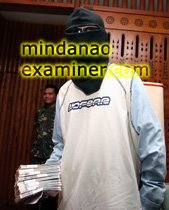
A masked civilian holds his P150,000 reward from the Philippine military on Friday 20 Oct 2006 in Zamboanga City. The man helped troops in capturing an Abu Sayyaf militant Isnain Aminul in Basilan island in 2004. Aminul is tagged as one of one of those who kidnapped US missionary couple Martin and Gracia Burnham and California man Guillermo Sobero, in Palawan island in 2001. (Mindanao Examiner/Uly Israel)


ZAMBOANGA CITY (Uly Israel / 20 Oct) - Southern Philippines military officials rewarded a civilian informant P150,000 for helping soldiers capture an Abu Sayyaf militant implicated in the kidnapping of three US citizens five years ago.
Philippine Army Brig. Gen. Francisco Callero handed the money to the masked informant inside the tightly guarded Western Mindanao Command headquarters in Zamboanga City. "This reward is part of the government program to encourage civilians to help us in the campaign against terrorism," he told the Mindanao Examiner.

The informant, wearing a sweat shirt and a pair of dark sunglasses, did not speak to reporters after receiving the money and was whisked away by soldiers. Callelero said the man led soldiers in capturing Isnain Aminul in Basilan island in 2004.

The military tagged Aminul as one of Abu Sayyaf gunmen who raided and kidnapped Kansas missionary couple Martin and Gracia Burnham and California man Guillermo Sobero and 17 Filipino holiday-makers on the posh Dos Palmas resort in the central Philippine island of Palawan in 2001.

Guillermo Sobero was beheaded in 2001 in Basilan island while Martin Burnham was shot dead a year later during a US-led military rescue operation in the province of Zamboanga del Norte.

The Abu Sayyaf had carried high-profile kidnappings in the past, including a daring raid on the Malaysian resort island of Sipadan in 2000 where it seized 21 Asian and European holiday-makers.

Washington offered as much as $5 million bounty for known Abu Sayyaf leaders, including its chieftain Khadaffy Janjalani. President Gloria Arroyo also put up P100 million rewards for the capture of the group's leaders and their members dead or alive. (With a report from Darwin Wee)