Showing posts with label Education. Show all posts

Wednesday, June 24, 2009

North Cotabato Youths Shout For Quality Education


Some 200 mostly students hold a rally Tuesday, June 23, 2009 in Kidapawan City in Mindanao to demand for equality and better education. (Mindanao Examiner Photo / Geo Solmerano)


KIDAPAWAN CITY, Philippines (Mindanao Examiner / June 24, 2009) – Some 200 mostly students held a rally in Kidapawan City in Mindanao to demand for equality and better education.

The students said they gathered Tuesday to show that they too, are part of those who want change in the government education system.
Many of them - members of the National Union of Students of the Philippines (NUSP) and Kabataang Artista para sa Tunay na Kalayaan (KARATULA) - came from different municipalities in North Cotabato.

"We just want to be heard," Ronnel Albiso, KARATULA president, told the Mindanao Examiner.

Albiso said they calling on the government to prioritize free education and to sustain various literacy programs in the country that will benefit the youth and make them better citizens in the future.

The students carried banners and placards that advocated quality education and better governance. The peaceful rally coincided with the celebration of the “All Youth and Students Day of Protest." (Nina Rodriguez)

Thursday, February 28, 2008

TESDA Mopahigayon Ug Massive Skills Training Program

Manila, Philippines (Mindanao Examiner / Feb. 28, 2008) - Ilusad karong tuiga sa Technical Education and Skills Development Authority (TESDA) ang massive skills training program ginamit ang tanang kapasidad pagbansay-bansay sa tibuok nasud nga network sa tekbok schools ang training centers.

Ang maong training gipunting alang sa regular nga programa sa tesda nga gibana-bana sa 597, 313 ka mga graduates. Dugang 50,000 ka mga graduates sa target ang sa training for work scholarship program ug ubang nga mga susamang training assistance services.

Ang maong pagbansay-bansay gipunting alang sa President Gloria Arroyo rural development program nga nagbarog sa 100,000 ka mga graduates.

Mao kini ang gitaho ni TESDA Director General Augusto Syjuco mahitungod sa massive training targets ug ang nagkatagdo nga mga programa ngadto kang presidente Arroyo panahon sa cabinet meeting ning milabay'ng Enero 2008, giingon sa Philippine Information Agency.

Saturday, January 12, 2008

Sulu To Send Muslim Clerics, Students Leaders On Education Tour In Malaysia, Saudi


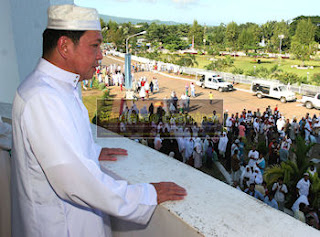
Sulu Governor Sakur Tan prays with other Muslims in Patikul town. Tan says he will send student leaders and Muslim clerics on educational tours in Malaysia and Saudi Arabia as part of a local government program aimed at enhancing their knowledge on Islam and Shari'a law. (Mindanao Examiner Photos/Nickee Butlangan and Mark Navales)


SULU, Philippines (Mindanao Examiner / Jan. 12, 2008) - Muslim clerics in the southern Philippine province of Sulu hailed a proposal to send selected clergies in other Muslim and Arab countries as part of a local education program.

Sulu Governor Sakur Tan, the proponent of the program, said sending ulama in countries like Malaysia and Saudi Arabia will further enhance their knowledge of the shari’a law, including philosophy, dialectical theology or Quoranic hermeneutics.

Usually, the fields studied and the importance given them will vary from tradition to tradition, or even from seminary to seminary.

“We will send the ulama to an education trip to further expose them and enhance more their knowledge of Islam, the shari’a and other fields,” Tan, himself a religious man, told the Mindanao Examiner.

The ulama in most nations consider themselves to represent the ijma (consensus) of the Ummah (community of Muslims) or to represent at least the scholarly or learned consensus. Many efforts to modernize Islam focus on the reintroduction of ijtihad and empowerment of the Ummah to form their own ijma.

In a broader sense, the term ulama is used to describe the body of Muslim clergy who have completed several years of training and study of Islamic sciences, such as a mufti, qadi, faqih or muhaddith.

Aside from the ulama, Tan said he will also send dozens of Muslim high school and college student leaders in Malaysia for an education tour where they would visit different schools and meet with other student leaders.

“The tour will give our students an opportunity to see and observe the educational system in Malaysia and mingle with Malaysian students and we can even propose or start an exchange program between Sulu and Malaysian students,” Tan said.

Education in Malaysia broadly consists of a set of stages which are Pre-school, Primary Education, Secondary Education, Tertiary Education and postgraduate studies. In 2003, Malaysia introduced the use of English as a medium of teaching in all science subjects.

Tan said the Sulu provincial government will spend for both the ulama and students education program which will begin this year.

“This is good and we long wanted to travel to other Muslim or Arab nations and observe the implementation of their respective shari’a law and other Islamic scholarly issues,” one Muslim cleric, who identified himself only as Ustadz Mohammad, said.

Tan, a known philanthropist in the southern Philippines, urged students to excel in their academics and pursue their goals so they can be a responsible citizen and future leaders of the province.

“Education is very important and only through education that we can help not only our family, but the government as well by becoming more responsible and a partner in nation building,” Tan, a former congressman, said. (With reports from Nickee Butlangan and Mark Navales)

Tuesday, November 06, 2007

Manila Promises More Education Opportunities

ZAMBOANGA CITY, Philippines - "Educating a nation cannot be accomplished by single individual or institution. Education is a shared responsibility," Department of Education (DepEd) Secretary Jesli Lapuz, said.

Lapuz admitted that limited resources especially budget availability has hampered the DepEd's effort to ensure the delivery of quality education.

With this burden, the government gladly welcomes non-government organizations and individuals supportive of uplifting the education and literacy rate in the country.

Lady Mayor Leonida A. Angcap of Midsalip for instance; beams with joy for the support it gets from Kapit-bisig Laban sa Kahirapan-Comprehensive and Integrated Delivery of Social Services (KALAHI-CIDSS) - a flagship project of the national government funded by World Bank and is implemented by the Department of Social Welfare and Development (DSWD).

Of the 7 CIDSS-recipient municipalities in ZDS, Midsalip, Matalang and Dumalinao has its farm to market road and level 2 water system contributory to improved livelihood opportunities, better school attendance of children and access to potable water.

Midsalip has 8-kilometer concrete road benefiting 7 barangays with 70% Subanen population. Manang Violeta, a resident joyfully said, 'karon nga miabot na namo ang kalsada, makakaon na mi lab-as nga isda" (with good road, we can now eat fresh fish". With good road, we can now easily transport patients to Pagadian and other cities, she added.

In Ticala, 93 pupils are now housed in a P1.3 million worth school building. 70% of which is a KALAHI grant while 30% of it is the LGU counterpart. "So far, this is the first big barangay project that we have, revealed Barangay Captain Yasser Samal.

Municipal Engineer Mossidic Calalagan, describes Ticala as a 90-hectare coco trees dominated island with 90 households who are peace-loving people mostly engaged in fishing.

Raised from Ticala and had his elementary education there, Calalagan said, children today are lucky to have a school in the island. He added that during his time, he used to paddle to and fro the mainland San Pablo daily for an hour through pump boat to finish elementary education.

Correspondingly, Zamboanga City District 1 Representative Beng Climaco, values education for youth. As a legislator, she advocates in the promotion of children's rights and welfare.

Recently, she forged partnership with the National Youth Commission (NYC), to conduct value education for the youth. Her kind of education involves the orientation of leaders like SK chair and members on their roles and functions of Sangguniang Kabataan officals that should be practiced based on virtues of goodness, honesty and good governance.

To continuously enjoy the momentum of more development opportunities coming in, President Gloria Macapagal-Arroyo at the caucus in Malacanang for key leaders of the administration coalition over the weekend squelched 'all humors and speculation that this country is divided.

The President revealed that she and the coalition leadership had 'agreed on a process of national consolidation, gathering all our allies around the common vision' towards national consolidation 'based on a coalition of principle and action.'

Good road, fresh fish as viand, potable water to drink, children's rights and welfare are indeed contributory factors among many, that paves the way for better opportunities in far-flung areas. And these are made possible through a focused vision, direction and GO-NGO partnerships, national consolidation and coalition of principle and action opens more opportunities specially to far-flung areas. (Mimi Edaga)

Friday, September 07, 2007

U.S., Australia Continue Mindanao Education Initiative


The joint EQuALLS-BEAM Beginning Reading Program helps teachers understand the learning process of children, classify them according to levels of school readiness, and effectively teach beginning reading in pilot schools in ARMM.


ZAMBOANGA CITY, Philippines - Building on previous collaborative efforts, the United States Agency for International Development (USAID) and the Australian Agency for International Development (AusAID) trained 134 teachers, school heads, and division supervisors from 18 public schools across the Autonomous Region in Muslim Mindanao (ARMM) on teaching beginning reading to Grade One students.

Called the Beginning Reading Program, the joint effort is carried out by USAID’s Education Quality and Access for Learning and Livelihood Skills (EQuALLS) and AusAID’s Basic Education Assistance for Mindanao (BEAM) program. The trainings were conducted on August 20-24 and August 27-31 in Cotabato City and Zamboanga City, respectively.

Teachers were trained in devising innovative and engaging methods of teaching beginning reading to first-graders.

They were likewise trained in assessing the readiness of pupils to begin formal schooling thereby allowing them to tailor-fit their lessons according to the readiness of the class.

Department of Education ARMM Secretary Udtog Kawit has acknowledged the contributions that USAID and AusAID are making to improve the capacity of teachers in ARMM, which is a region that continues to require significant assistance to develop teaching capacity and provide students access to quality basic education.

Mrs. Shirley Dawila, principal of Provincial Housing Lab Elementary School in Bongao, Tawi-Tawi, says “the Beginning Reading program will help us solve the problem of non-readers in our school. After this training, I want to witness the teacher’s class and see to it that she follows the program.”

Earlier this year USAID and AusAID jointly trained 4,000 teachers in the ARMM on teaching English, science, and math. Two other follow-through trainings are set for November this year and January next year.

EQuALLS’ partnership with the BEAM project for the Beginning Reading program is a step towards EQuALLS’ goal of improving education quality in Mindanao, especially in areas where learning is disrupted by poverty and conflict.